Converging on Opposite Tacks
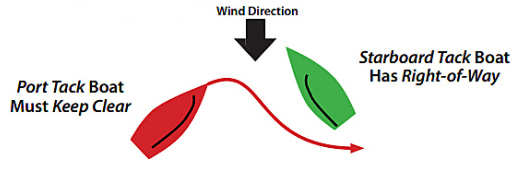
Rule 10, “When boats are on opposite tacks, a port-tack boat shall keep clear of a starboard-tack boat.”
Rule 14, “A boat shall avoid contact with another boat if reasonably possible.”
Note: Your tack is determined by the side the wind is blowing from (not the side your sail is on).
I’m on port-tack, can I cross that starboard-tack boat safely?
A Common Scenario
You’re heading upwind (beating) on port-tack and you can see that you may be converging with a boat off in the distance that is on a starboard-tack. You know that you must keep clear but you really don’t want to tack just yet. How can you know if you can cross in front of the other boat safely?
Crossing Safely
Using a transit (land-sight or line of sight) is generally considered the most accurate and reliable way to judge a collision course. A transit uses a fixed point on the horizon to provide an objective measurement.
Pick the Transit: Look past the bow of the boat on starboard-tack and find a stationary object on the shore (a house, a water tower, a specific tree, or even a distant cloud if you’re far offshore).
Align the Boat: Line that fixed object up with a specific part of the other boat, for example its bow.
Observe the Gap Between the Transit and the Bow
- Increasing: If the distance between the transit and the bow is increasing, you will cross ahead of them.
- Decreasing: If the distance between the transit and the bow is decreasing, they are crossing ahead of you. You are the “give-way” vessel – make sure you pass behind them or tack away.
- Stationary: If the bow stays locked onto the distance to the transit, you are on a collision course, and must take action, either by ducking or tacking away (but make sure you do this in plenty of time).
Clear Communication
When you’re the port-tack boat and you realize the land-sight is stationary, clear communication is vital between you and the starboard-tack boat to prevent them from “hunting” you or crash-tacking in panic. Being loud and clear is often more important than the formal rulebook.
Hunting: On a beat to windward, a starboard boat cannot bear away (hunt) if it forces a port-tack boat—who is already trying to go behind them – to immediately change course again to avoid a hit. (Rule 16.2).
Hold Your Course! Ducking You!
If you realize you cannot cross and intend to duck (pass behind) the Starboard boat, shout: “Hold your course!” or “Ducking you!”
The Big Duck
Don’t make a subtle course correction. the other helmsman can’t always see a 5° change in your heading. Turn the boat decisively downwind (aiming for their transom).
Hand Signals
If it’s windy or you’re too far away to be heard, literally point your arm toward their stern (the transom). This tells the other skipper exactly where you intend to go.
If you are 100% sure you increasing the distance, sometimes referred to as “making trees”, and will cross ahead, a quick “thank you” wave or a forward-pointing motion can reassure them that you’ve calculated the distance.
If in doubt, bail out!
If you’re on port-tack and not sure that you’re gonna be able to cross safely, it’ll be much safer to take avoiding action, early. The damage resulting from a port-starboard t-bone can be huge.
And remember, even though starboard tack has the right of way, they must still do everything possible to avoid a hit (Rule 14). Clear shouting from the port boat makes that much easier for everyone.
Summary:
The Upwind Port – Starboard Encounter
When two boats converge on opposite tacks, the starboard-tack boat has the right of way. The port-tack boat is the “give-way” vessel and must decide early to:
- Duck: Ease sails slightly and pass behind the starboard boat (the safest option).
- Tack: Change direction to parallel the starboard boat’s course.
- Cross: Only attempt to cross ahead if there is a clear, wide margin of safety.
If you are on Port and force the Starboard boat to change course to avoid you, you have broken rule 10. When in doubt, duck early.